Place as Balance Sheet
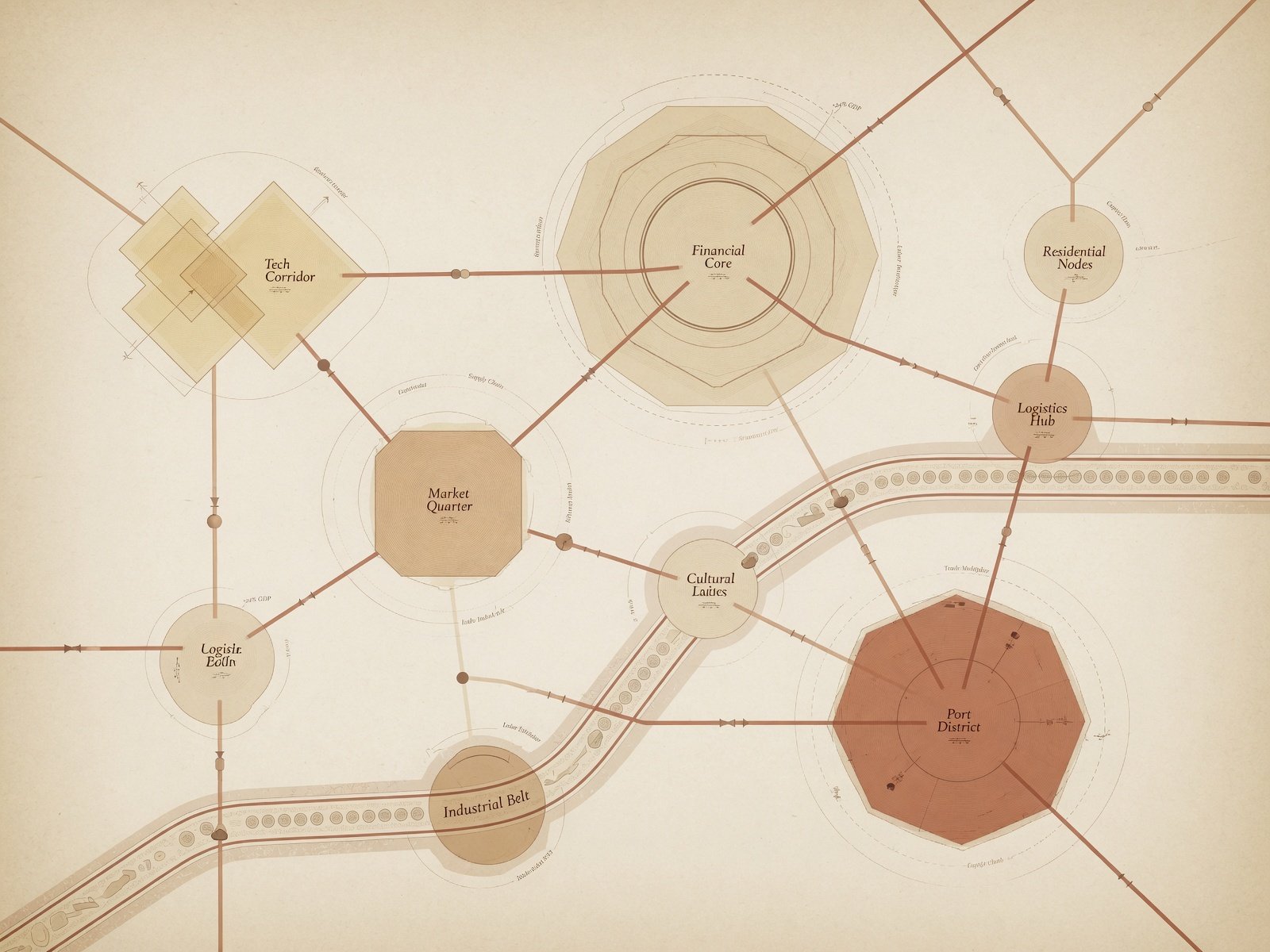
Land, infrastructure, skills, and reputation form a city's assets. Congestion, decay, and distrust are its liabilities. Mesoeconomics accounts for both.
A New Economic Scale
Mesoeconomics treats the city as the coherent economic unit — neither the firm nor the nation-state, but the living system where capital, labor, land, and trust actually meet.
Coherent Unit
One city. One ledger.

Where people live, produce, and settle value — the city is already the real central bank.
Urban liquidity
Issued by place
01 — The Thesis
Classical economics oscillates between the atom of the firm and the abstraction of the nation. Mesoeconomics restores the missing middle: the city as a living balance sheet.
“A city is not a smaller country. It is a different kind of economic organism — dense enough to price risk, intimate enough to hold trust, and large enough to issue its own order.”
— Core principle of Mesoeconomics
Firms, households, and contracts. Necessary, but blind to place.
Cities and metro regions. Where production, settlement, and culture cohere.
Nations and currencies. Powerful, yet often too coarse for urban reality.
02 — Pillars
A practical vocabulary for treating cities as issuers of stability, not mere recipients of national policy.
Land, infrastructure, skills, and reputation form a city's assets. Congestion, decay, and distrust are its liabilities. Mesoeconomics accounts for both.
Value settles where people sleep, work, and trade. Cities can steward credit, municipal currency layers, and clearing systems tuned to local velocity.
Policy that fits the metro region — housing, transit, energy, and talent — outperforms national averages when cities act as integrated economic units.
Cities remain open systems. Mesoeconomic autonomy is not isolation — it is the right to set local rules while exchanging with peer cities worldwide.
03 — Core Principles
Mesoeconomics sits between microeconomics, which studies individual behaviour, and macroeconomics, which studies national aggregates. It treats the city as the fundamental unit of modern economic activity, and these six principles define how that plays out.
Cities exercise autonomous control over their economic policies, free from excessive national constraints, while maintaining cooperative relationships with neighbouring cities and regions.
Each city issues and manages its own currency layer, allowing precise calibration of monetary supply to match local economic conditions and community needs.
Decisions rest on hyper-local economic indicators rather than broad national averages, enabling more accurate and effective policy responses.
Cities form economic partnerships and trading networks, creating a federated system that balances local autonomy with regional cooperation.
Wealth is kept circulating within the local economy, strengthening community resilience and reducing dependence on external economic forces.
Active engagement and education of citizens in economic governance, fostering democratic participation in monetary policy decisions.
Localised
Economic power distributed to communities
Responsive
Policies adapted to real-time local needs
Resilient
Communities less vulnerable to global shocks
04 — City as Central Bank
Zoning is credit policy. Transit is liquidity infrastructure. Housing supply is inflation control. Public procurement is open-market operations. Mesoeconomics makes this implicit banking explicit — accountable, designed, and coherent.
Municipal and civic credit lines backed by tax capacity, land value, and productive capacity — not only sovereign debt markets.
City-scale clearing reduces friction for wages, rent, utilities, and small enterprise, keeping velocity inside the metro system.
Insurance, housing finance, and infrastructure bonds can reflect neighborhood realities better than national averages.
Cities can hold diversified reserves — energy, land banks, digital settlement assets — to stabilize shocks without waiting for the capital.
Tax base
→ Collateral
Public works
→ Open market ops
Land policy
→ Monetary stance
Currency exchange
Cities maintain exchange rates with neighbouring jurisdictions, facilitating trade and commerce.
Trade agreements
Bilateral and multilateral agreements create stable economic relationships.
Regional networks
Cities form economic zones with shared standards while keeping their sovereignty.
05 — Framework
Four interlocking layers turn a city from a passive jurisdiction into a coherent economic unit capable of self-banking.
Inventory assets, liabilities, cash flows, and informal trust networks across the functional urban area.
Set transparent criteria for local credit, land-value capture, and infrastructure-backed instruments.
Connect payments, procurement, and civic platforms so value recirculates with low friction.
Link with peer cities for trade, reserves, and shared standards — autonomy without autarky.
Contrast
Dimension
Unit of analysis
Conventional
Firm or nation-state
Mesoeconomics
Functional city / metro region
Dimension
Source of money
Conventional
Distant central bank only
Mesoeconomics
National rails + local credit issuance
Dimension
Policy lag
Conventional
Slow, nationally averaged
Mesoeconomics
Fast, place-specific feedback
Dimension
Collateral
Conventional
Sovereign debt & corporate assets
Mesoeconomics
Land, tax capacity, commons, skills
Dimension
Citizen engagement
Conventional
Limited and indirect
Mesoeconomics
Direct and democratic
Dimension
Risk distribution
Conventional
Centralised, systemic
Mesoeconomics
Distributed, resilient
Dimension
Innovation
Conventional
One-size-fits-all
Mesoeconomics
Experimental, diverse
Dimension
Success metric
Conventional
GDP growth aggregates
Mesoeconomics
Urban prosperity & systemic resilience
Policies can be calibrated to local conditions, industries, and challenges. A city with a large tech sector can run a different monetary stance than one built on manufacturing, so each instrument does more work.
When economic power sits across many cities rather than one national centre, the whole system becomes harder to break. A crisis in one city does not automatically cascade, creating natural firewalls against systemic collapse.
06 — Benefits
Moving economic authority to the meso scale pays off across three dimensions at once: economic, social, and political.
07 — Manifesto
A concise charter for mayors, planners, founders, and citizens who want their metro region to act with the seriousness of a central bank — and the humanity of a neighborhood.
Endorse the principlesThe city is the primary coherent unit of economic life.
National currency is a shared rail; local credit is a civic responsibility.
Land value is social surplus and must recycle into public capacity.
Infrastructure is monetary policy conducted in concrete and code.
Openness to peer cities is the condition of durable autonomy.
Measurement must follow functional urban areas, not only administrative lines.
Trust is a balance-sheet asset — slower to build, faster to lose.
Mesoeconomics serves residents first: shelter, work, mobility, and dignity.
08 — Cases & Futures
Mesoeconomics is not speculative. Local currency systems have been running for decades, and they tell us a great deal about what city-scale money can and cannot do.
United Kingdom
A local currency initiative that kept money circulating within the community.
Lesson Community currencies can strengthen local economies and build business networks.
Germany
A regional currency serving multiple communities across Bavaria.
Lesson Regional currencies can span multiple cities while keeping local benefits intact.
Sardinia, Italy
A mutual credit network enabling businesses to trade without cash.
Lesson Credit-based systems can supply liquidity when conventional currency is scarce.
Blockchain-based local currencies with programmable monetary policy, enabling automated responses to economic indicators and transparent governance.
Potential Real-time policy adjustment and democratic voting on economic measures.
Networks of cities maintaining individual currencies while participating in shared exchange mechanisms and monetary standards.
Potential Local autonomy with the depth of a larger economic zone.
Cities distributing newly created currency directly to residents, implementing a localised form of universal basic income.
Potential Equitable distribution of the benefits of monetary expansion.
Start with small-scale local currency experiments in willing neighbourhoods.
Develop the digital platforms and regulatory frameworks the system runs on.
Gradually grant cities broader monetary policy powers as capacity is proven.
Create inter-city alliances and the exchange mechanisms that bind them.
09 — About Us
The Mesoeconomic practice is an independent research and design studio working on the missing middle of economics. We publish frameworks, city case studies, and implementation guidance for the people who actually run urban systems: mayors, treasurers, planners, founders, and the residents who live with the results.
Founder
Monetary economist
“The future of economics is not national or global. It is local. Cities have always been the engines of innovation, culture, and commerce. Mesoeconomics simply gives them the tools to govern their own prosperity.”
Dr Pejvak Kokabian
Dr Pejvak Kokabian is a monetary economist whose work sits at the intersection of central banking theory and urban political economy. His research asks a question conventional macroeconomics rarely poses: if the city is where capital, labour, land, and trust actually meet, why is it the one scale with no monetary authority of its own?
That question became the mesoeconomic framework set out on this site. It treats zoning as credit policy, transit as liquidity infrastructure, housing supply as inflation control, and public procurement as open-market operations, then makes that implicit banking explicit, accountable, and designed.
He founded Mesoeconomic to move the framework from theory into civic practice, working with municipal institutions on metro ledgers, local credit issuance rules, and the clearing rails that let value recirculate inside a city rather than drain out of it.
Books by the founder
Placeholder links. Replace each href with the
book's Amazon product URL.
Get in touch
Have questions about mesoeconomics, city case studies, or monetary framework implementations? Reach out to our team or join the mesoeconomic dialogue.
Thank you for reaching out. We will be in touch shortly.